What Is in the NeuroLift Proprietary Blend and How Does It Compare to Study Doses?
Quick answer
The NeuroLift proprietary blend is a 635 mg mix of ten ingredients, listed in order of weight without a separate amount for each. Four amounts are printed: B12 240 mcg, folate 600 mcg DFE, magnesium 250 mg and chromium 120 mcg. Ginkgo, bacopa and L-theanine at their trial doses would need 740 mg by themselves.
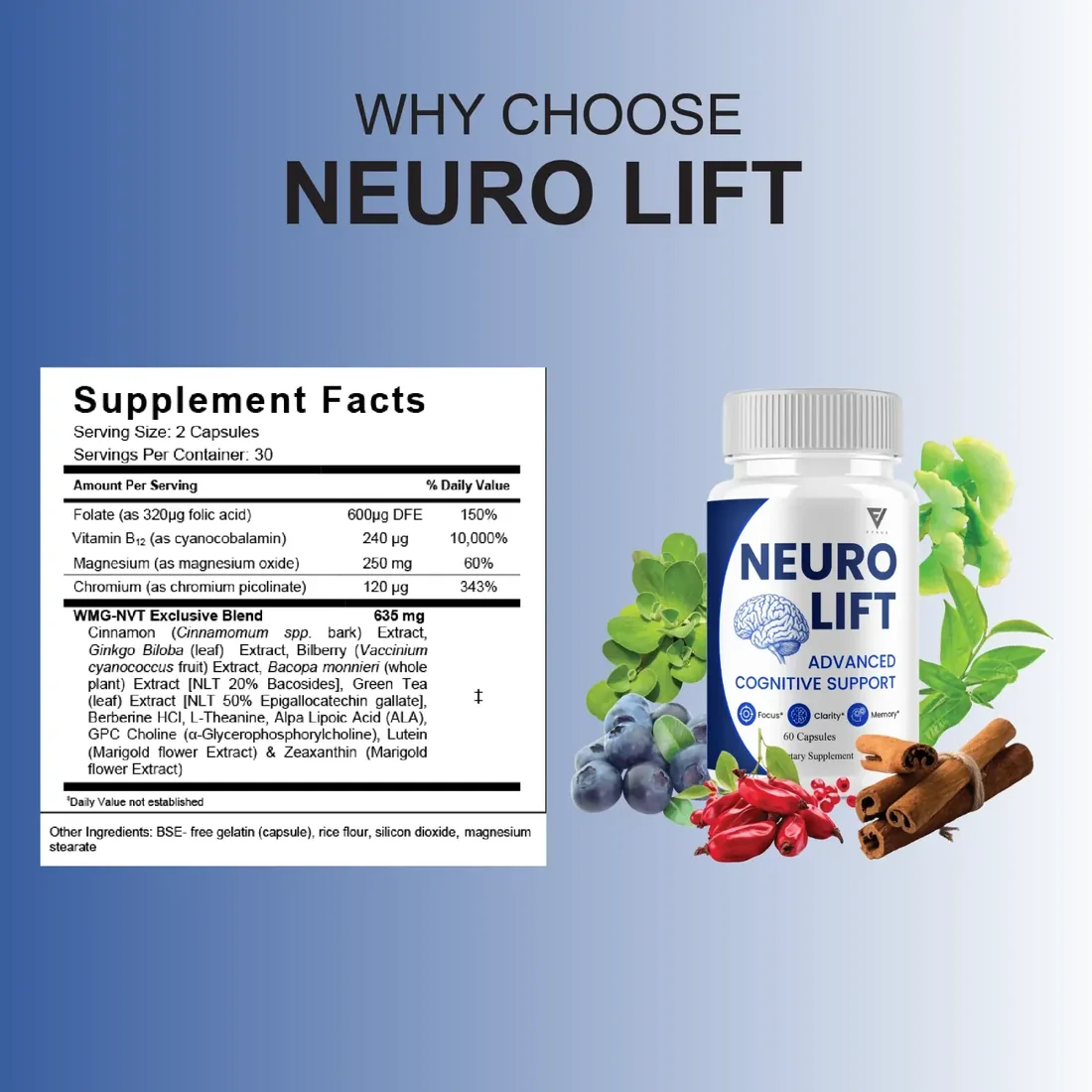
A Neuro Lift label has two kinds of numbers. Four nutrients carry exact amounts, and ten botanicals and compounds share one 635 mg total. Here is what each kind can tell you, and how the blend compares with the doses studies used.
Which numbers does the Neuro Lift label give, and which does it hold back?
It gives the serving (2 capsules, 30 per bottle), four nutrient amounts and the names in the WMG-NVT Exclusive Blend. It does not say how much ginkgo, bacopa or any other botanical sits in a serving.
7 of 12 key facts are published
- Product name and formPublished
- Capsules per bottlePublished
- Daily servingPublished
- Ingredient namesPublished
- Vitamin and mineral amountsPublished
- Label warnings and storagePublished
- Prices (eBay listing)Published
- Amount of each blend ingredientNot published
- Manufacturer name and addressNot published
- Return policy beyond eBay'sNot published
- Third-party lab reportNot published
- Study of this productNot published
Every line of the panel appears on our Neuro Lift Supplement Facts page.
Thinking about Neuro Lift? The best price is on the 15-bottle pack.
15 bottles for $152.88, $10.19 a bottle. eBay Money Back Guarantee · Free US shipping · Secure checkout.
What do the four printed amounts mean?
They are real, checkable numbers, but a big percent Daily Value is not a memory benefit. Read each one next to its safety limit.
| Nutrient on the label | % DV printed | What the number means | Limit or study context |
|---|---|---|---|
| Folate 600 mcg DFE (320 mcg folic acid) | 150% | The DV is 400 mcg DFE. | Folic acid limit 1,000 mcg a day; trials at 400 to 2,500 mcg found no thinking benefit (NIH ODS, Folate (health professional)) |
| Vitamin B12 240 mcg (cyanocobalamin) | 10,000% | B12 has no set upper limit; harm is unlikely. | No thinking gain in people who were not short of it (NIH ODS, Vitamin B12 (health professional)) |
| Magnesium 250 mg (oxide) | 60% | The DV is 420 mg; oxide absorbs less fully than citrate. | 350 mg a day is the cap for supplements; oxide often loosens stools (NIH ODS, Magnesium (health professional)) |
| Chromium 120 mcg (picolinate) | 343% | The DV is only 35 mcg. | No upper limit is set; one small 26-person memory trial (Nutr Neurosci 2010, Krikorian et al., Chromium and cognition) |
Two catches hidden in these numbers
First, folic acid can hide a B12 shortage until nerve damage may become permanent (NIH ODS, Folate (health professional)). Anyone with memory changes should have B12 measured by a doctor.
Second, the directions read 2 capsules daily "or as needed". Four capsules would give 500 mg of magnesium, well over the 350 mg supplement limit, so never take more than 2 a day unless a clinician says so. The magnesium page has the detail on oxide and the stomach.
Why is a proprietary blend a problem for buyers?
Because it hides the one number you need to compare a product with research. Under FDA labeling rules, a blend lists its total weight and its ingredients in order from most to least by weight, and only ingredients with a Daily Value must show their own amounts (FDA, Dietary Supplement Labeling Guide, Ch. IV).
A 2023 Journal of Nutrition paper says a blend label cannot tell you how much of any one ingredient you take. Researchers must test the product or ask the maker, who need not answer (J Nutr, Perspectives on proprietary blends).
Three things you lose
- The research match. Trial results apply to the dose tested, so no blend ingredient can be checked against its trial.
- The safety math. Green tea extract has been tied to rare liver injury, and berberine can affect how some medicines are cleared. Without amounts, nobody can size up either one.
- The fair comparison. Two brands can list the same ten names at very different strengths.
What does WMG-NVT stand for?
We could not find out. The label does not explain it, and a web search turned up nothing.
Is 635 mg enough room for the doses trials used?
Not all together, and for most ingredients not even alone. Ginkgo at 240 mg, bacopa at 300 mg and L-theanine at 200 mg add up to 740 mg, which is 105 mg more than the entire blend.
The ceiling each ingredient cannot pass
Label order gives one more clue. If the maker followed the FDA rule, each line weighs no more than the one above, so the 4th can weigh no more than one quarter of 635 mg, the 7th one seventh, and so on. These are ceilings from simple division, not measured amounts.
| Label position and ingredient | Most it could weigh | Dose used in studies | Could it reach that dose? |
|---|---|---|---|
| 1. Cinnamon bark extract | about 635 mg | No memory studies in people | Nothing to match |
| 2. Ginkgo biloba leaf extract | about 317 mg | 240 mg a day (GEM) | Only if ginkgo and cinnamon took 480 mg or more |
| 3. Bilberry fruit extract | about 211 mg | No memory studies | Nothing to match |
| 4. Bacopa monnieri extract | about 158 mg | 300 to 450 mg a day for 12 weeks or more | No, about half the lowest |
| 5. Green tea leaf extract | about 127 mg | Trials measured EGCG | Cannot be worked out |
| 6. Berberine HCl | about 105 mg | Studied for blood sugar, not memory | Nothing to match for memory |
| 7. L-theanine | about 90 mg | 50 to 400 mg, most often 200 mg | Only the 50 mg low end |
| 8. Alpha lipoic acid | about 79 mg | 600 to 900 mg a day in Alzheimer's trials | No |
| 9. Alpha-GPC (GPC choline) | about 70 mg | 1,200 mg a day, only in dementia | No, under 6% of it |
| 10. Lutein and zeaxanthin (marigold extract) | about 63 mg | 10 mg lutein plus 2 mg zeaxanthin | Unclear: lutein share not printed |
Bacopa, the ingredient with the best small trials, sits 4th and cannot pass about 158 mg. Our Neuro Lift ingredients page covers all ten.
Label amount next to studied dose, drawn to scale
The bars below set each printed amount against the lowest dose used in trials. Rows marked "Amount not published" are blend ingredients, where the label gives no number to draw.
Label: 240 mcg. Studied: about 500 to 1,000 mcg a day in trials (helps only when someone is low). (NIH ODS, Vitamin B12 (health professional)) (Cochrane, Folic acid with or without B12 for cognition)
Label: 320 mcg (600 mcg DFE). Studied: about 400 to 2,500 mcg folic acid a day in trials. (NIH ODS, Folate (health professional)) (Cochrane, Folic acid with or without B12 for cognition)
Label: not published. Studied: 240 mg a day (GEM trial, about 6 years). (JAMA 2009, Snitz et al., GEM cognitive decline trial)
Label: not published. Studied: 300 to 450 mg a day for 12 weeks or more. (J Ethnopharmacol 2014, Bacopa meta-analysis of RCTs)
Label: not published. Studied: 50 to 400 mg, often 200 mg, short term. (Nutr Rev 2025, Payne et al., tea and L-theanine meta-analysis)
Label: not published. Studied: 1,200 mg a day, only in people with dementia. (Alzheimer's Drug Discovery Foundation, Alpha-GPC)
Label: not published. Studied: 10 mg + 2 mg a day for 12 months. (Nutrients 2021, Yagi et al., Lutein and brain health)
The B12 and folic acid bars stop short of trial doses yet pass the Daily Value, which counts only for someone who is low.
What should you take from this if you are weighing Neuro Lift?
Treat every blend ingredient in Neuro Lift as an unknown amount, likely below trial doses for most. The printed vitamins mainly help people who are low.
- Stick to 2 capsules a day. Chasing a trial dose would push magnesium past its limit first.
- You can ask the order desk at +1 (302) 200-3480 for the blend amounts. They do not have to share them.
- On blood thinners, diabetes medicine or several prescriptions? Show the ingredient list to a pharmacist.
For the bigger picture, read do brain supplements work?
Neuro Lift blend vs research: FAQ
What is the most ginkgo a Neuro Lift serving could hold?
About 317 mg, if the blend follows the FDA order rule, since ginkgo is listed 2nd of ten. The real amount is not printed and could be far lower.
Could Neuro Lift contain 300 mg of bacopa?
Not if the label follows the FDA order rule. Bacopa is 4th in the blend list, so it can be no more than about 158 mg per serving, about half the 300 mg minimum that trials used.
What does "proprietary blend" mean on the Neuro Lift label?
Ten ingredients sit under one shared weight, heaviest first. Ingredients without a Daily Value need no amount of their own.
Is the 10,000% B12 figure on the Neuro Lift label too much?
The 240 mcg is far above the label reference value. B12 has no set upper limit, so it is not a danger signal, but it is no memory benefit unless you are low.
Is 250 mg of magnesium oxide a lot?
It covers 60% of the Daily Value and stays below the 350 mg daily cap for supplements. Oxide is a form often linked to loose stools, and other magnesium supplements or medicines add to the total.
Can I take 4 capsules of Neuro Lift to get closer to trial doses?
We would not. Four capsules give 500 mg of magnesium, above the 350 mg supplement limit, and still could not reach the alpha-GPC or alpha lipoic acid doses used in trials.
What does proprietary blend mean on the NeuroLift label?
It means the maker lists the ingredients and a combined weight, 635 mg here, but not the amount of each one. Ingredients are listed in order of weight, so earlier names hold more.
Can NeuroLift match the doses used in studies?
Not by label math. Ginkgo, bacopa and L-theanine at trial doses would need 740 mg, which is more than the whole 635 mg blend, so the capsule cannot reach those doses.
Page check
Written by
Writes and fact-checks every page against the Supplement Facts panel, the back label and public health sources.
Medically reviewed by
Dr. Gianna Link, MD, PhD, MD, Physician
Medical reviewer. Review date: October 12, 2026.
- Last checked October 12, 2026
- Facts from the bottle, the sales page and the sources cited above
- Found an error? Write to [email protected] or read how we check facts