How Does Neuro Lift Work? A Look at Each Ingredient
Quick answer
Neuro Lift works through its individual ingredients, each studied on its own.
B12 and folate matter for people with a shortage, bacopa and L-theanine showed small attention effects, and berberine, cinnamon, chromium and ALA were tested for blood sugar.
Browse the ingredient list.
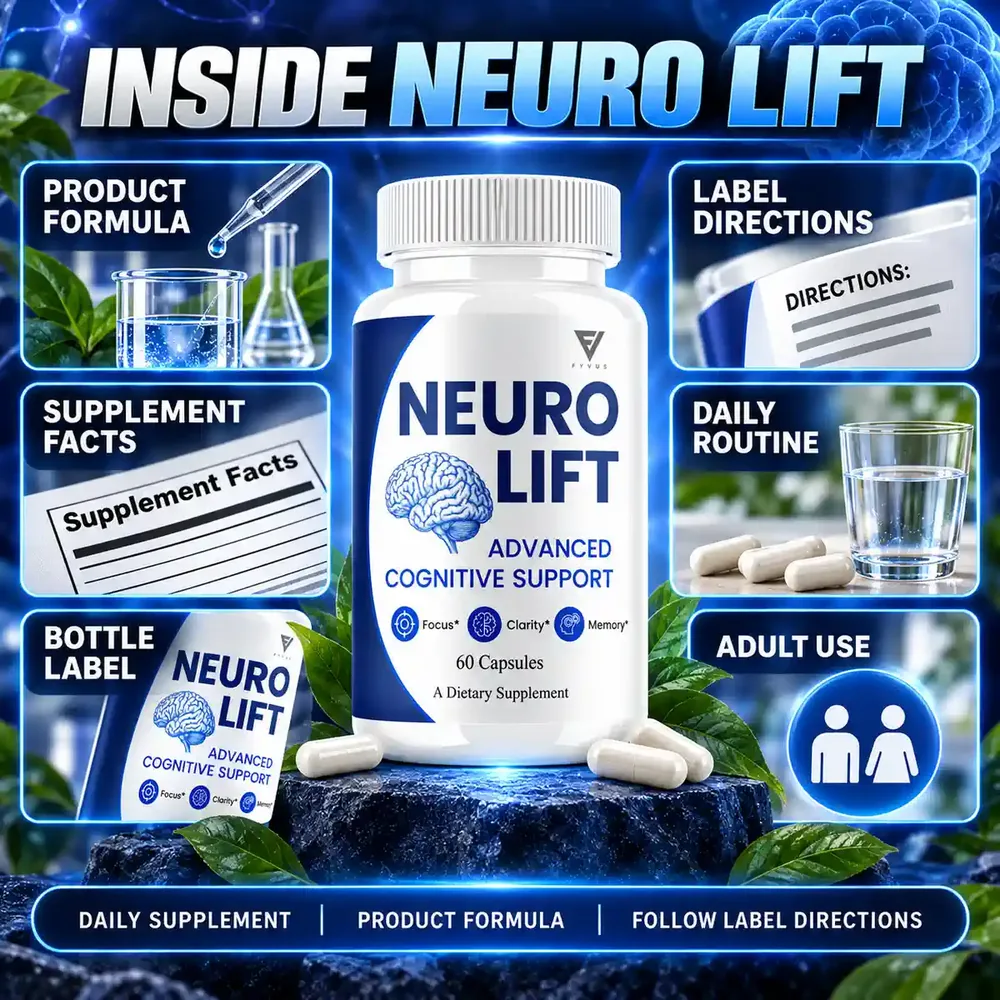
Does the brand explain how Neuro Lift works?
Not in terms of the body. Its graphic titled "How Neuro Lift works" lists habits and paperwork, not a process inside you, and no study of the formula is named anywhere.
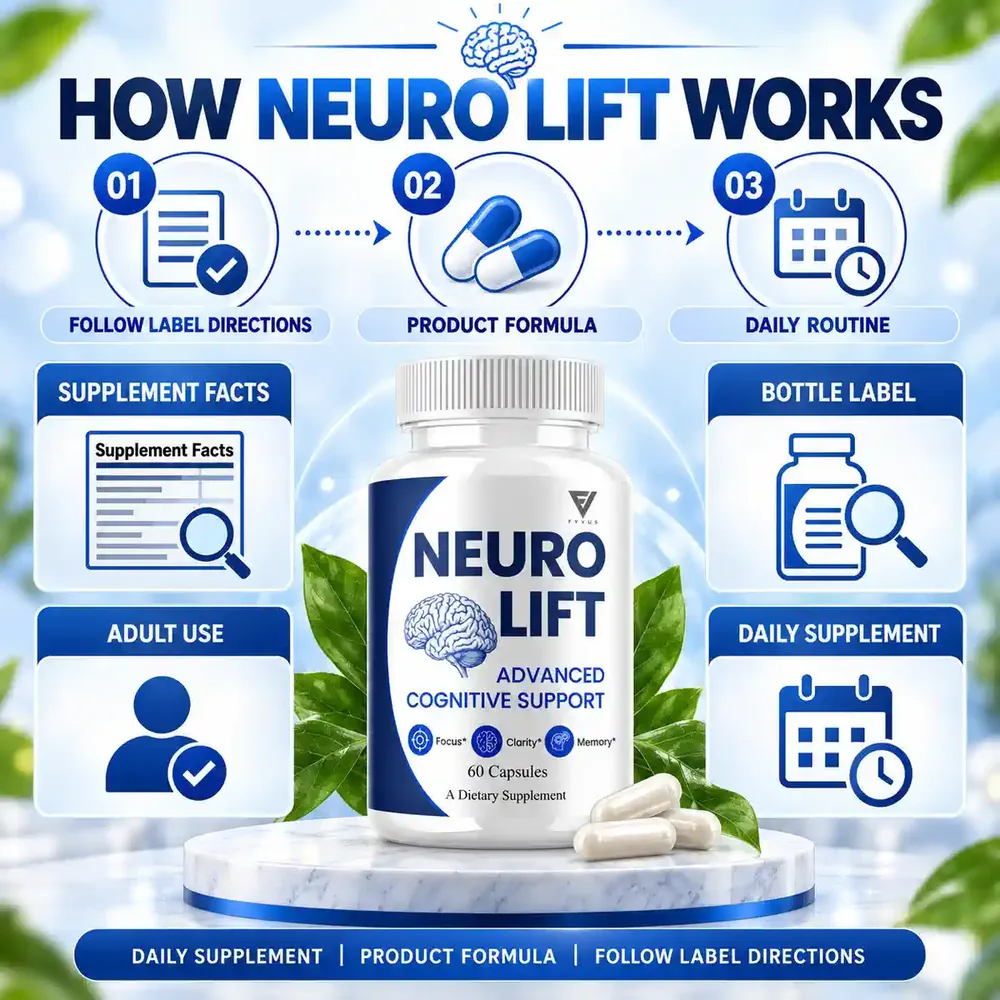
The three numbered steps are follow the label directions, the product formula and a daily routine. Four more tiles say supplement facts, bottle label, adult use and daily supplement.
That is sound advice for taking any supplement, but it is not a mechanism. The label adds the FDA statement: these claims were not evaluated, and the product is not meant to diagnose, treat, cure or prevent any disease. So the only honest route is to look at each ingredient's own research, which is what the rest of this page does.
What has each ingredient been shown to do?
Sorted by what research actually measured, the 14 Neuro Lift ingredients fall into eight groups. Tap a group to see the finding and the dose that produced it.
Vitamin B12 and folate
Fills a shortage
Low B12 can bring tiredness and nerve changes, even without anemia (NIH ODS, Vitamin B12 (health professional)). When levels were already normal, B vitamin pills barely changed thinking scores over as long as five years.
Studied at: 500 mcg B12 with 400 mcg folic acid a day for 2 years, in adults 65 and older.
Bacopa and L-theanine
Short attention tasks
Across nine bacopa trials with 518 people, Trail B and choice reaction times got shorter (J Ethnopharmacol 2014, Bacopa meta-analysis of RCTs). L-theanine sped up choice reaction within an hour of taking it, with wide uncertainty.
Studied at: Bacopa 300 to 450 mg a day for 12 weeks or more; L-theanine 50 to 400 mg.
Green tea extract
Tea as a whole
A review of 21 studies saw the clearest effects when caffeine and L-theanine came as a pair, and said no single part of tea gets the credit (Phytomedicine 2017, Mancini et al., Green tea and cognition).
Studied at: 9 to 300 mg of EGCG a day in thinking trials.
Ginkgo biloba
Tested, no benefit
The GEM trial followed 3,069 adults aged 72 to 96. Ginkgo did not slow decline in thinking compared with a placebo (JAMA 2009, Snitz et al., GEM cognitive decline trial).
Studied at: 120 mg twice a day, median 6.1 years.
Alpha-GPC
Dementia only
A source of choline. It may help people already diagnosed with dementia, and nobody has tried it in healthy adults (Alzheimer's Drug Discovery Foundation, Alpha-GPC).
Studied at: 400 mg three times a day.
Lutein and zeaxanthin
Scans, not scores
Small trials in older adults found changes on brain scans rather than better memory test results (Nutrients 2021, Yagi et al., Lutein and brain health).
Studied at: 10 mg lutein plus 2 mg zeaxanthin a day for 12 months.
Berberine, cinnamon, chromium, ALA
Blood sugar, not memory
All four have been tested for blood sugar, with weak or negative results (NCCIH, Diabetes and Dietary Supplements). Only chromium has a memory trial, with 26 people; ALA has no usable dementia trial.
Studied at: No memory dose for berberine or cinnamon; ALA used 600 to 900 mg in Alzheimer's trials.
Bilberry and magnesium
No clear role
No condition is clearly helped by bilberry, and magnesium has too few memory trials for a verdict (Adv Nutr 2024, Chen et al., Magnesium and cognitive health).
Studied at: No memory dose for either.
Only the first group has printed amounts that match up with research. Every other group depends on a dose the label does not show.
Thinking about Neuro Lift? The best price is on the 15-bottle pack.
15 bottles for $152.88, $10.19 a bottle. eBay Money Back Guarantee · Free US shipping · Secure checkout.
Why can no one say how the whole capsule works?
The formula has no trial of its own, and most of its doses are hidden. Four numbers sum up the gap.
The 740 mg is ginkgo at 240 mg, bacopa at 300 mg and L-theanine at 200 mg. Blend labels give names and one combined weight, which leaves any single dose a mystery (J Nutr, Perspectives on proprietary blends).
According to the FTC, a health claim must rest on competent and reliable science, with randomized human trials the strongest kind; lab or animal results alone fall short (FTC, Health Products Compliance Guidance).
What would have to be true for Neuro Lift to work?
Four things, one after the other. A gap at any link breaks the chain, and today three links cannot be checked.
- 1
Enough of an ingredient
A trial dose has to reach you. For bacopa that is 300 mg; the label prints no bacopa amount.
- 2
A gap to fill
B12 and folate do their work in people running short. With normal levels, the extra does little.
- 3
Enough time
Bacopa needed at least 12 weeks in trials. The label gives no timeline.
- 4
Proof for the mix
The 14 ingredients have never been tested together. This link is missing.
What a realistic wait looks like is on the Neuro Lift results timeline.
Why does the label say "support" instead of "improve"?
Because the wording decides whether the law treats a product as a supplement or a drug. A product meant to treat, prevent, cure or ease a disease counts as a drug even with a supplement label (FDA, FDA 101: Dietary Supplements).
That is why Neuro Lift prints Focus*, Clarity* and Memory* with an asterisk, and why the back label says it is not intended to diagnose, treat, cure or prevent any disease. The FDA did not review these lines, and it does not approve supplements for safety or effectiveness before sale. The maker carries that duty, and nothing public shows how it was met for this formula.
Can the ingredients work against you?
Yes, mainly through stacking and medicines. Several ingredients push in the same direction, so their effects can add up in ways a single-herb study never sees.
| Effect | Ingredients | Who should ask first |
|---|---|---|
| May lower blood sugar (NCCIH, Diabetes and Dietary Supplements) | Berberine, chromium, cinnamon, ALA | People on insulin or diabetes pills |
| May raise bleeding risk (Memorial Sloan Kettering, Ginkgo (About Herbs)) | Ginkgo | People on blood thinners, aspirin or NSAIDs |
| Changes how drugs are broken down (Memorial Sloan Kettering, Berberine (About Herbs)) | Berberine | Anyone on prescription medicine |
The Neuro Lift side effects page gathers every reported reaction in one place.
How Neuro Lift works: questions people search
How does Neuro Lift work?
Nobody knows for certain, because the full formula has never been tested. Its parts were studied one at a time, for attention, B vitamin shortages or blood sugar.
Is Neuro Lift clinically proven?
No. We found no published trial of the product. Any study you read about concerns a single ingredient at its own dose.
Do brain supplements work?
A few single ingredients show small, short-lived effects, and no supplement has a proven record against dementia or decline. Most multi-ingredient blends, Neuro Lift among them, hide the doses those studies used.
Has anyone studied Neuro Lift?
We found no published study. Every trial cited here tested bacopa, ginkgo, L-theanine or another part on its own, never the Neuro Lift capsule.
Is Neuro Lift a stimulant?
Not on paper. No caffeine appears on the label, and the focus-linked ingredients were measured on attention speed, not alertness.
Why is berberine in a memory supplement?
The brand gives no reason. Research on berberine covers blood sugar and weight, not memory, and it changes how several medicines are processed.
How long does Neuro Lift take to work?
The bottle gives no timeline. Bacopa needed 12 weeks or more in trials, and six years of ginkgo showed no benefit.
Is Neuro Lift a treatment for ADHD?
No. It is a dietary supplement for adults, not a treatment for ADHD or any other condition, and it is not for children.
Page check
Written by
Writes and fact-checks every page against the Supplement Facts panel, the back label and public health sources.
Medically reviewed by
Dr. Gianna Link, MD, PhD, MD, Physician
Medical reviewer. Review date: October 12, 2026.
- Last checked October 12, 2026
- Facts from the bottle, the sales page and the sources cited above
- Found an error? Write to [email protected] or read how we check facts